Requirements
Define purpose, constraints, mass, safety and validation targets.
A structured civilian and educational track that connects flight systems, electronics, mechanical design, assembly, calibration, testing and manufacturing.
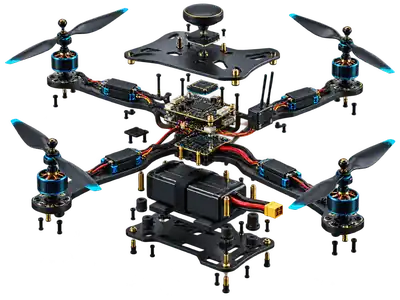
Understand the core drone subsystems and how airframe, propulsion, power, control and sensors interact, with safety-first operation.
Choose frame geometry, materials, mass distribution, center of gravity and maintainable component mounting.
Understand brushless motor, propeller and ESC matching, including size, rotation direction and load effects.
Build a controlled power path covering battery, connectors, protection, distribution, voltage and current monitoring.
Learn the flight controller, IMU, barometer and compass roles, with sensor-fusion fundamentals for attitude stabilization.
Plan signal, power and ground wiring, reduce noise coupling and document the wiring map before assembly.
Configure motor and sensor orientation, calibrate measurements and set safe-stop behavior for signal loss or faults.
Understand closed-loop control and P/I/D effects, using gradual tuning in a controlled test environment.
Turn a prototype into a repeatable build using CAD, mounts, distribution PCBs, BOMs, manufacturing files and quality checks.
Use an assembly and validation sequence that begins propeller-free, then electrical, functional and calibration checks before any permitted flight test.
A complete capstone covering requirements, frame, power, control, BOM, assembly, testing and engineering documentation.
Define purpose, constraints, mass, safety and validation targets.
Frame geometry, component layout, center of gravity and CAD.
Power, flight controller, sensors, wiring and compatibility.
Assemble a controlled prototype and complete propeller-free bench checks.
Calibration, functional tests, controlled tuning and acceptance records.
BOM, CAD, PCB files where needed, assembly instructions and QA gates.
A brushless propulsion motor used with a compatible ESC and propeller in a drone system.
Technical profile →DRONE COMPONENTThe mechanical structure carrying motors, power and electronics while defining clearance and mass distribution.
Technical profile →DRONE COMPONENTThe aerodynamic element converting motor torque into thrust; it must match the motor and rotation direction.
Technical profile →DRONE COMPONENTAn electronic controller that drives a brushless motor from flight-controller commands.
Technical profile →DRONE COMPONENTThe central controller that reads sensors, computes stabilization commands and drives propulsion outputs.
Technical profile →DRONE COMPONENTA satellite-positioning module for civilian educational applications requiring position or ground-speed data.
Technical profile →DRONE COMPONENTAn inertial measurement unit typically combining gyroscope and accelerometer sensing for vehicle attitude and motion estimation.
Technical profile →DRONE COMPONENTA high-power lithium-polymer battery pack requiring appropriate charging, storage and safety inspection.
Technical profile →DRONE COMPONENTA board or subsystem that distributes battery power to propulsion and control electronics.
Technical profile →DRONE COMPONENTA receiver that passes operator or control-station commands to the flight controller using a supported protocol.
Technical profile →The lab now has draft foundations for an educational quadcopter, a propulsion test rig and a flight-controller bench. They remain internal until BOM, engineering verification, testing and references are complete.
OHMFORGE Drone Lab is for civilian, educational and engineering learning. It does not cover weaponization, offensive payloads, safety-control bypasses or evasion of applicable operating rules.